
The 0.001 BTC Test: Grading One Machine on a Small Target
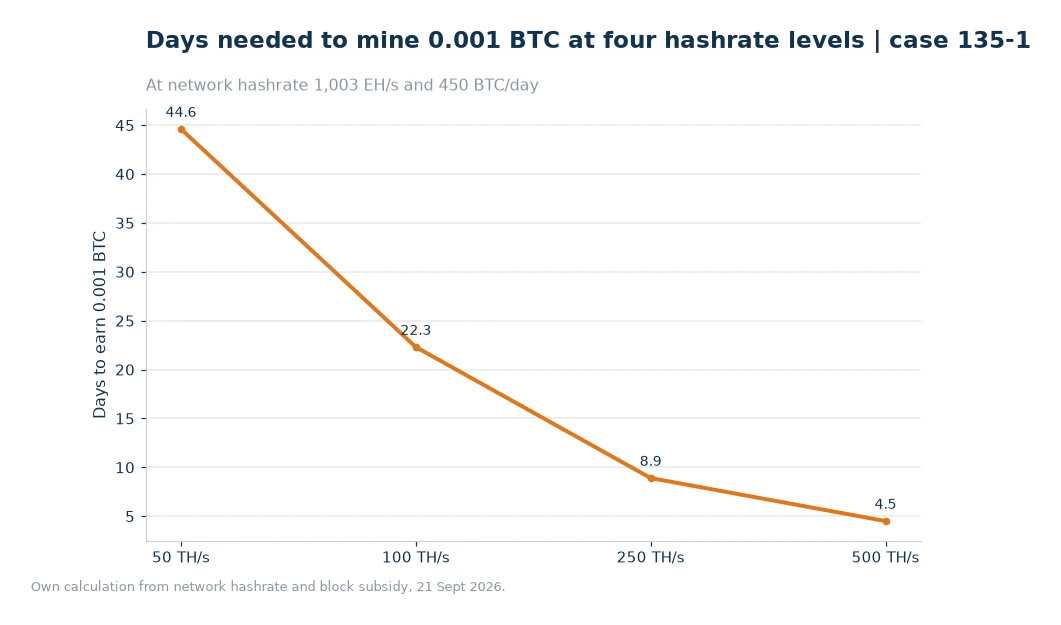
Before committing a rig to months of running, put it through a target small enough to finish quickly. One thousandth of a bitcoin is worth $84.69 at $84,692, and at 100 TH/s it takes 22.3 days to accumulate. That is short enough to observe a full cycle and long enough for the result to mean something. Treat it as a test with a pass mark rather than as a payout to celebrate.
Key takeaways
- 0.001 BTC is $84.69 at $84,692, small enough to reach in 4.5 days at 500 TH/s.
- At 100 TH/s the target takes 22.3 days, which is long enough to expose a flaky power supply or a bad cable.
- Pool Hashrate and Pool Luck belong in the reading, but a PPS+ credit is driven by difficulty rather than by luck.
- A first-week total of 0.00031402 BTC at 100 TH/s is the figure to compare against the pool's dashboard.
A small target is a diagnostic, not a jackpot
The value of a low target is that it completes inside the period when a new machine is most likely to misbehave. Thermal paste, a marginal riser, a fan that stops at a certain temperature: these problems show up as gaps in a hashrate series long before they show up in a monthly total. A 22-day window catches most of them while the seller's return period is still open.
The pass mark should be set in advance. Write down the expected daily credit, the expected number of credits, and the tolerance you will accept before calling the test failed. A useful tolerance is a few percent, because the pool credits against difficulty rather than against luck under PPS+, so the series should be smooth. If the observed total is 15% short, something local is wrong and the test has done its job.
What a thousandth of a bitcoin actually represents
In dollar terms it is a modest sum, roughly the price of a mid-range consumer component. That makes it easy to dismiss, which is a mistake when the purpose is verification rather than income. The figure is small because the window is short, not because the hardware is unimportant. Judging a machine by a test target is like judging a car by a short motorway run: the point is to see whether anything rattles, not to measure the annual fuel bill.
It also sets a natural first-withdrawal threshold. A miner who wants to move coins early can use 0.001 BTC as the trigger and leave the rest accumulating, which keeps the withdrawal small and the transaction simple. That habit is worth forming before the balance is large enough for a stuck confirmation to hurt.
Pool Hashrate, Pool Luck and the first reading
When the first credit lands, two comparisons are worth making. The first is between the pool's reported hashrate for your account and the figure on the machine's own interface. The second is between the credited amount and the arithmetic you did before starting. Pool Hashrate and Pool Luck explain the pool's public block history, but under PPS+ they do not explain a shortfall in your credit, so a gap points at the local setup rather than at the pool's fortune.
The ViaBTC BTC Mining Pool view puts both figures in one place, with the pool's own hashrate beside the network total. Bookmark it for the week of the test and read it at the same time each day; the comparison is only meaningful when the readings are taken on a consistent schedule.
That is a useful diagnostic property. Luck-based schemes blur the signal, because a slow start can be either a local fault or an unlucky pool. With hourly settlement against difficulty, the expected credit is stable enough that a deviation is informative. Keep the first week's daily figures side by side and the pattern will be obvious within a few days.
Where the test can mislead
Three things can make a passing test look better than it is. The first is price: 0.001 BTC was worth $84.69 on the read date, and the dollar value of the target moves with the market while the BTC amount does not. A machine that hits the BTC target has done exactly what the arithmetic said, whatever the dollar figure happens to be that week.
The second is difficulty drift. A 22-day window is short enough that one adjustment may not land inside it, which is good for the test and bad for extrapolation. Do not multiply the test week by fifty-two and call it an annual forecast; the network total in twelve months will not be the one used here.
The third is the temptation to over-clock. A machine pushed past its efficient point can pass a short test and then fail in month three when a fan or a power supply gives out. The test measures delivery, not durability, so leave a margin between the setting used and the setting the hardware is comfortable with.
Four machines against a one-week window
The table shows the target and the first seven days together, because the week is what a new owner actually observes before the target completes.
| Machine | Coins per day | Days to target | Coins after one week |
|---|---|---|---|
| 50 TH/s | 0.00002243 | 44.6 | 0.00015701 |
| 100 TH/s | 0.00004486 | 22.3 | 0.00031402 |
| 250 TH/s | 0.00011215 | 8.9 | 0.00078505 |
| 500 TH/s | 0.00022430 | 4.5 | 0.00157010 |
Worked example
Take the 100 TH/s machine, since it sits in the middle of the test window and is easy to check by hand.
- Network output per TH/s: 450 spread over 1,003,000,000 TH/s is 4.4865e-7 BTC daily, about 4.5e-07.
- At 100 TH/s: 100 × 0.00000044865 = 0.00004486 BTC a day, or 4.486e-05.
- Days to 0.001 BTC: 0.001 ÷ 0.00004486 = 22.3 days.
- First week: 7 × 0.00004486 = 0.00031402 BTC, about 31% of the target.
- Three days: 3 × 0.00004486 = 0.00013458 BTC, which is the first meaningful checkpoint.
- Value of the target: 0.001 × 84,692 = $84.69; the first week is worth about $26.59.
The first checkpoint is the one to watch. If three days produce less than 0.00011 BTC at this hashrate, the machine is not delivering what its rating implies, and the cause is almost always local: a throttled fan curve, a power supply running below its rating, or a pool connection dropping shares. Finding that in week one is cheap. Finding it in month six is not.
Frequently asked questions
Is 0.001 BTC a sensible first target for a new miner?
Yes, because it completes in 22.3 days at 100 TH/s and 4.5 days at 500 TH/s, which is long enough to reveal a local fault and short enough to keep the test cheap.
What should the first week produce at 100 TH/s?
About 0.00031402 BTC, or 31% of the target, based on 0.00004486 BTC a day; a materially lower figure suggests a local problem rather than pool variance.
Does Pool Luck explain a slow first week?
Not under PPS+, where the block-reward component settles hourly against difficulty; luck affects PPLNS payouts, so a PPS+ shortfall should be traced to the machine, its power or its connection.
Run the test before the fleet
Set the expected daily credit, run for three days, compare, then run to the full target. If the machine passes, the later decision about a second unit rests on arithmetic you have already verified rather than on a specification sheet. The Statistics page gives the network total for the division, and the ViaBTC App makes the daily series easy to watch on a phone, which is where most faults are noticed first.
Sources: ViaBTC pool-state, statistics and pricing pages, where Pool Hashrate and Pool Luck are reported; 4% is the listed rate on the block-reward side[1]. Snapshot 21 Sept 2026: 1,003 EH/s, 3.125 BTC per block, 144 blocks per day, BTC $84,692. Published 24 October 2026; test figures assume constant difficulty and full uptime.